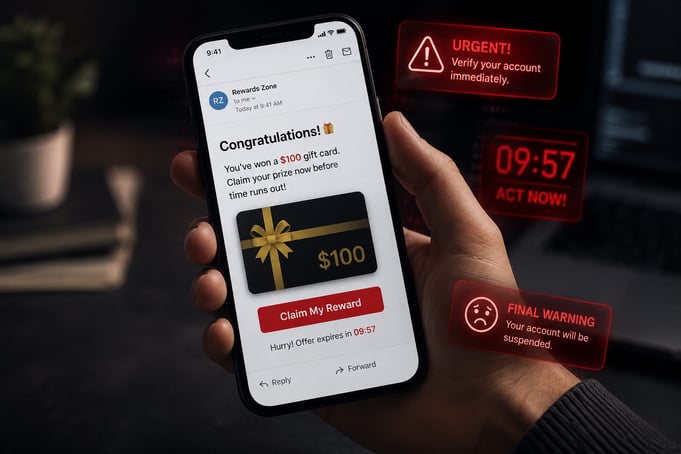
You open your inbox and see a message that says: "Congratulations! Claim your free reward."
Or maybe it's: "Final reminder. Your package is on hold."
At first glance, nothing seems unusual. The design looks professional. The company name appears familiar. There may even be a countdown timer urging you to act quickly.
That's exactly what today's phishing scams are designed to do.
Cybercriminals have become less reliant on obvious spelling mistakes and suspicious-looking emails. Instead, they focus on something much more effective: your emotions.
Whether they're offering an unexpected reward or creating a false sense of urgency, the goal is always the same.
Get you to click before you stop to think.
Warning Sign #1: Unexpected Rewards
"You've won."
"Your reward is waiting."
"Claim your exclusive gift."
If you never entered a contest, signed up for a promotion, or requested a refund, be skeptical.
Scammers know that unexpected rewards trigger excitement. That emotional response often happens before you have time to question whether the offer is legitimate.
A simple question can save you:
Did I actually expect to receive this?
If the answer is no, verify it before taking any action.
Warning Sign #2: Urgency and Pressure
Scammers love countdowns.
"Expires in 10 minutes."
"Final reminder."
"Immediate action required."
These messages are designed to make you believe you don't have time to think.
In reality, legitimate businesses rarely pressure customers into making immediate decisions through unexpected emails or text messages.
If a message tries to rush you, that's your cue to slow down.
Warning Sign #3: Strong Emotional Reactions
Most phishing attacks follow the same emotional pattern.
First comes excitement.
Then comes fear.
You feel excited because you've supposedly won something.
Moments later, you're told you'll lose it unless you act immediately.
That emotional swing isn't accidental.
It's carefully designed to override good judgment.
Whenever a message makes you feel excited, anxious, or pressured, pause before responding.
Before You Click
Whether it's an email, text message, or social media notification, take a few seconds to verify before you interact.
Ask yourself:
- Was I expecting this message?
- Does the sender look legitimate?
- Am I being rushed into making a decision?
- Is this trying to make me react emotionally?
Those few questions can stop many phishing attempts before they begin.
The Bottom Line
Phishing scams don't just target your devices.
They target your instincts.
The prize.
The countdown.
The final reminder.
They're all engineered to make you act first and think later.
The next time a message makes you feel something...
Pause. Then verify.
Those few extra seconds may be the simplest and most effective cybersecurity habit you can develop.
Sources